
1916 Irish Volunteers and Irish Citizen Army

Within the Nominal Rolls series, there are a number of files which specifically deal with the events of 1916.

Easter Week Dublin Brigade General - RO11

This file brings together letters, statements, articles, and lists relating to participation in the 1916 Easter Rising, with a particular focus on Dublin.

Personal recollections, by Piaras Béaslaí and others, outline the organisation, strength, and activities of Irish Volunteer units in areas such as Church Street and Brunswick Street, as well as key locations including the Marrowbone Lane Distillery.

Further correspondence and notes centre on the Jacob’s Factory garrison, incorporating detailed lists of those involved. A compiled list, drawn from pension records, identifies individuals active across major Rising sites, including the GPO, Four Courts, Ashbourne, and Kerry.

Official correspondence also documents applications for military service pensions submitted by participants.

Published extracts from An Cosantóir recount engagements at Mount Street Bridge and Ashbourne.

The file additionally includes a GPO Roll of Honour and a substantial alphabetical register of 467 individuals, providing detailed biographical and service information such as names, ranks, units, addresses, and pension reference.

Irish Citizen Army - RO10A

The Irish Citizen Army (ICA) was founded in late 1913 by James Larkin, James Connolly and Jack White as a workers militia to physically defend the trade union movement from attacks by the police during the 1913 Lockout. Approximately 220 of its members took part in the 1916 rebellion at the General Post Office (GPO), St Stephen’s Green, City Hall and other locations. Seventeen of its members were killed and more than a dozen were wounded.

The file contains correspondence between the Referee’s Office and the Advisory Committee under the Military Service Pensions Act (1934) and former members of the Irish Citizens Army (I.C.A.), mainly concerning the gathering of evidence for pension applications.

It includes an unsworn statement by John O’Neill, former Commandant of the I.C.A.(1916–1922), focusing largely on the organisation and activities of the I.C.A. after 1916.

Also present are several lists and records relating to I.C.A. members, including:

  • a typed list of names and addresses associated with St. Stephen’s Green,
  • a document issued by Pádraig Ó Bróin compiling officers and NCOs (1921–1923), outlining service from 1920 to 1923, and seeking further information to support a history of the I.C.A.,
  • a handwritten list of I.C.A. officers in 1916, and
  • a detailed multi-page register of members covering 1916 to the end of the Civil War, noting names, ranks, addresses, service periods, locations, and suggested pension grades.

The women of the Irish Citizen Army played a crucial role in the Easter Rising. Unlike many other military groups of the time, the ICA actively included women as full members: trained, armed, and involved in combat and leadership. The ICA’s inclusion of women reflected socialism and labour equality ideals. It stood in contrast to other groups like Cumann na mBan, where women were more often restricted to auxiliary roles.
On the listings can be found: Countess Markievicz, Helena Molony, Rosie Hackett, Margaret Skinnider, Winifred Carney, the Gethings sisters (Ellen and Eily), Lily Kempson and many others. 

Read more about the Irish Citizen Army.

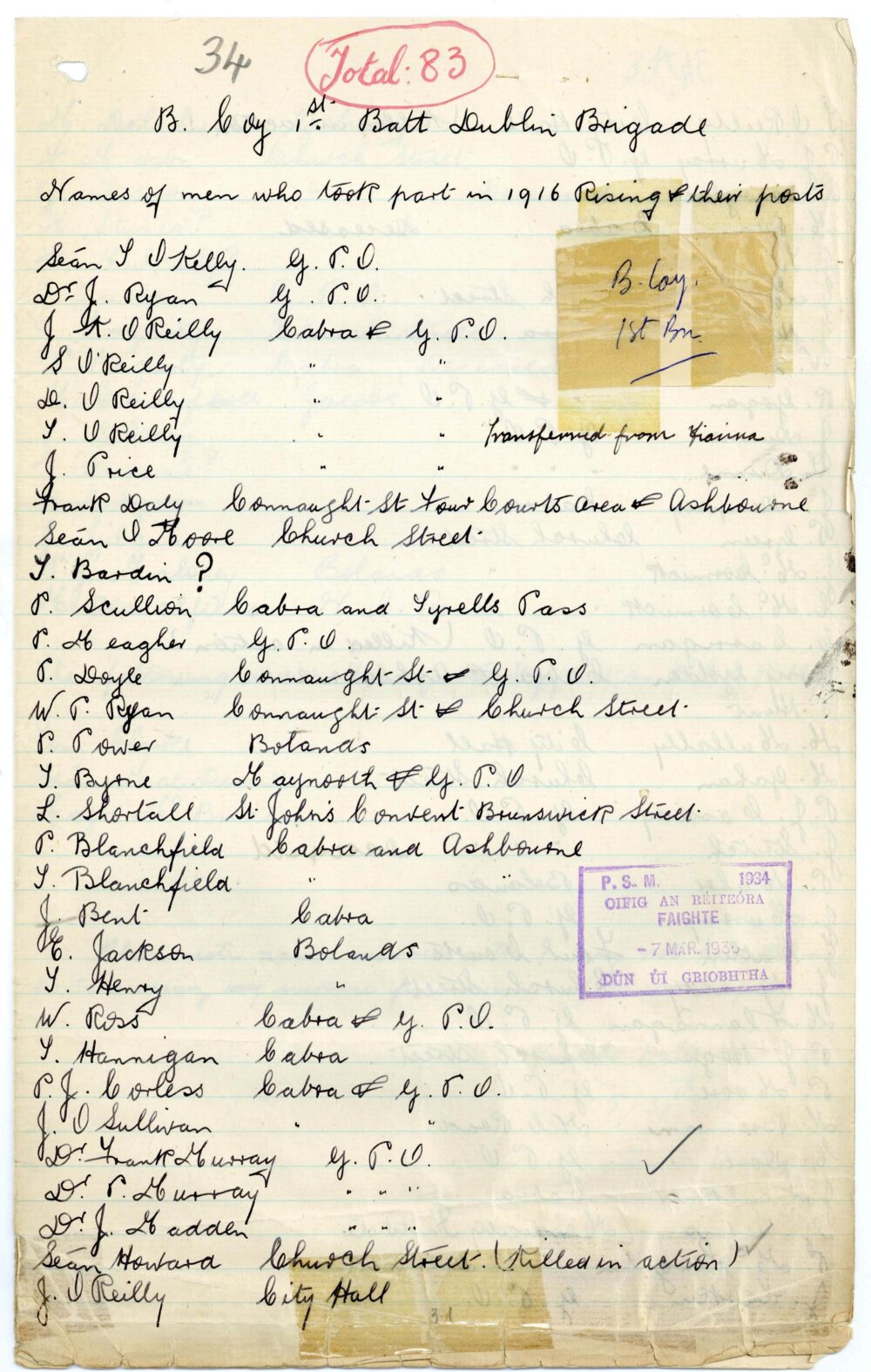
1st Battalion Dublin Brigade - RO12

The file contains listings of members of the 1st Battalion, Dublin Brigade, Irish Volunteers, compiled by officers including Nicholas Laffan, Fionán Lynch, Patrick Holohan, and Frank Fahy and detailing those who served in key areas such as North King Street, Church Street, Upper Brunswick Street, and the Four Courts during Easter Week 1916. It also includes lists from A, B, C, D, and F Companies, as well as associated units and Na Fianna.

Additionally, the file includes correspondence with the Referee’s Office (Military Service Pensions Act, 1934) and several participants, discussing the organisation, strength, and activities of the battalion during the Rising.
Locations: North Brunswick St, Church St, King St, North King St, Cabra, GPO, City Hall, Mendicity Hall, Broadstone, Linenhall, Colmcille Hall.

2nd Battalion Dublin Brigade - RO13

The file contains letters and handwritten lists of members of the 2nd Battalion, Dublin Brigade, Irish Volunteers, compiled by Frank Henderson, covering F, E, and D Companies and their service during Easter Week 1916. It also includes correspondence with the Referee’s Office and Oscar Traynor concerning the battalion’s membership and activities during the Rising.
Locations: GPO, Jacob’s Factory, Stephen’s Green, Boland’s Mills,

3rd Battalion Dublin Brigade - RO14

The file contains handwritten lists of members of the 3rd Battalion, Dublin Brigade, Irish Volunteers, compiled by officers including Joseph O’Connor, Joseph O’Byrne, and Simon Donnelly, detailing those who served at Boland’s Mills and surrounding areas during Easter Week 1916.

It also includes a request for a certificate of service, correspondence relaying Éamon de Valera’s recollections of battalion strength, and a detailed account of the Boland’s Mills garrison’s activities during the Rising.

Locations: Boland’s Mills, Ringsend

4th Battalion Dublin Brigade - RO15

The file contains handwritten and typed lists of members of the 4th Battalion, Dublin Brigade, Irish Volunteers, compiled by several officers, detailing participation in Easter Week 1916, including company membership, service locations, and, in some cases, later involvement in the National Army or anti-Treaty forces.

5th Battalion (Fingal) Dublin Brigade - RO16

The file contains listings by Joseph V. Lawless detailing the strength, membership, and activities of the Fingal Battalion before and during Easter Week 1916, including service locations and individuals who joined from other units. It also includes correspondence from Richard Mulcahy outlining his recollections of the battalion and directing further sources of information.

Kimmage Garrison 1916 - RO607

The Kimmage Garrison, a secret Irish Volunteers camp set up by the Plunkett brothers, trained IRB members who spent months making weapons for the Easter Rising. On Easter Monday 1916, George Plunkett led volunteers by tram into the city, where they joined others at Liberty Hall before marching to seize the General Post Office.

The file contains a list of 95 members of the Kimmage Garrison during the Easter Rising of 1916. It includes details such as participation in the march to Beresford Place and the GPO on 24 April 1916, addresses, employment, and whether individuals were deceased or killed, with some names crossed out but still readable.

Tyrrellspass 1916 - RO503B

The Tyrellspass Volunteers were sustained by the backing of a local nationalist priest, Fr. Smith—so much so that they were sometimes referred to as “Fr. Smith’s Volunteers”—as well as by the leadership of the well-connected republican Malone brothers. The unit had been assigned to participate in the 1916 Rising, but amid the widespread confusion following Eoin MacNeill’s countermanding order, its members ended up surrounded by the local RIC at the Malone family home in Meedin. Patrick Seery spent Easter Week there with the Tyrellspass company, though he appears to have escaped arrest in the aftermath of the rebellion.

The file contains a handwritten list (with a photocopy) of 22 Irish Volunteers who served in Tyrrellspass and South Westmeath during Easter Week 1916, noting their addresses, days of service, and some later activities, compiled and authenticated by local pension committee members and former officers. On the list: Patrick/Paddy Seery of Clooneyheigue and the Malone brothers (Meedin), James, Joseph and Tomas. Tomas was imprisoned at Richmond Barracks in Dublin before being transferred to Wandsworth prison in London. Finally he was sent to Frongoch internment camp in Wales. He was released in August 1916.

Read more: A Revolution in Profiles - Co Offaly (in Asociation with the Royal Irish Academy)

Manchester IRA - RO608

The file contains very little information about 1916. However, documents describe the formation and activities of Irish Volunteer companies in Manchester from 1913 through 1921. They outline early organisation, support work for the Easter Rising and later IRA efforts (including smuggling arms to Ireland), and detail operations such as prison escapes, arson attacks on industrial and farm properties, and clashes with police, followed by arrests and imprisonments of members.
Interesting names of 1916 participants are mentioned: Laurence/Larry Ryan, William Parr, Gilbert Lynch (successful claim), and Edmond O’Dwyer (unsuccessful claim).

Hibernian Rifles

The Hibernian Rifles were a small Irish nationalist militia formed in the early 1900s after a split within the Ancient Order of Hibernians. Based in Dublin, they aimed to promote Irish independence and were less sectarian than similar groups.

They supported labour causes during the 1913 Dublin Lockout and developed links with other nationalist organisations like the Irish Citizen Army, although they were not fully trusted by the Irish Republican Brotherhood. By 1915, they had become a more organised armed group and published a nationalist newspaper.

During the Easter Rising of 1916, a small number of members (around 20–30) chose to participate, fighting mainly at the General Post Office. Although limited in size and not involved in planning the rebellion, they contributed willingly and played a minor but notable role.

In the collection

There is no file on the organisation in the Nominal Rolls series but we know that some members were awarded service pensions and medals as the organisation was recognised under the pension legislation. 
There is one file in the administration series listing some members in 1916 (not complete). 
Below are the relevant pages. 

 John Joseph Scollan, who acted as a conduit for confidential messages between James Connolly and Arthur Griffith and elements based in the United States of America (1913-1916).  

Notable members include the Healys: Christopher Healy (Phibsborough Road, Dublin) and his daughters, Teresa (736) and Cathleen (2277). His son, John Healy (147) was wounded at Byrne's Corner in Phibsborough when serving as a despatch courier. He died on 25 April 1916 at the Mater Hospital.